Climbing Mount Fuji: The Honest Guide
Everything verified for the 2026 season — the ¥4,000 fee, hut prices, the four trails compared, and the one mistake that ruins more climbs than fitness or weather.
Do it once. Climbing Mount Fuji is a long, cold, crowded slog up a heap of volcanic gravel, and almost everyone who finishes it is glad they did. The trick is going slowly enough to enjoy the fact that you got there.
Book first, then train. The mountain is gated now — no hut reservation means no afternoon start, and no proper boots means no start at all. Once you are through that, the whole climb comes down to one instruction that every climber who struggled up there repeats: go slower than feels natural.
Before You Go Anywhere
Fuji stopped being a mountain you can turn up at. Sort these four things now, in this order, because the first one sells out and the rest depend on it.
- Book a mountain hut. From about ¥7,000 a bed without meals, ¥9,000–17,000 with dinner and breakfast. They fill up months ahead in season, and without a confirmed booking the trailheads are shut to you between 2pm and 3am. Note what that does and does not ban: a one-day, up-and-down daylight climb is perfectly allowed — start early, be down by evening. What the gate kills is the overnight “bullet climb” to the sunrise without a hut — a distinction people get wrong so often that climbers find themselves correcting it constantly.
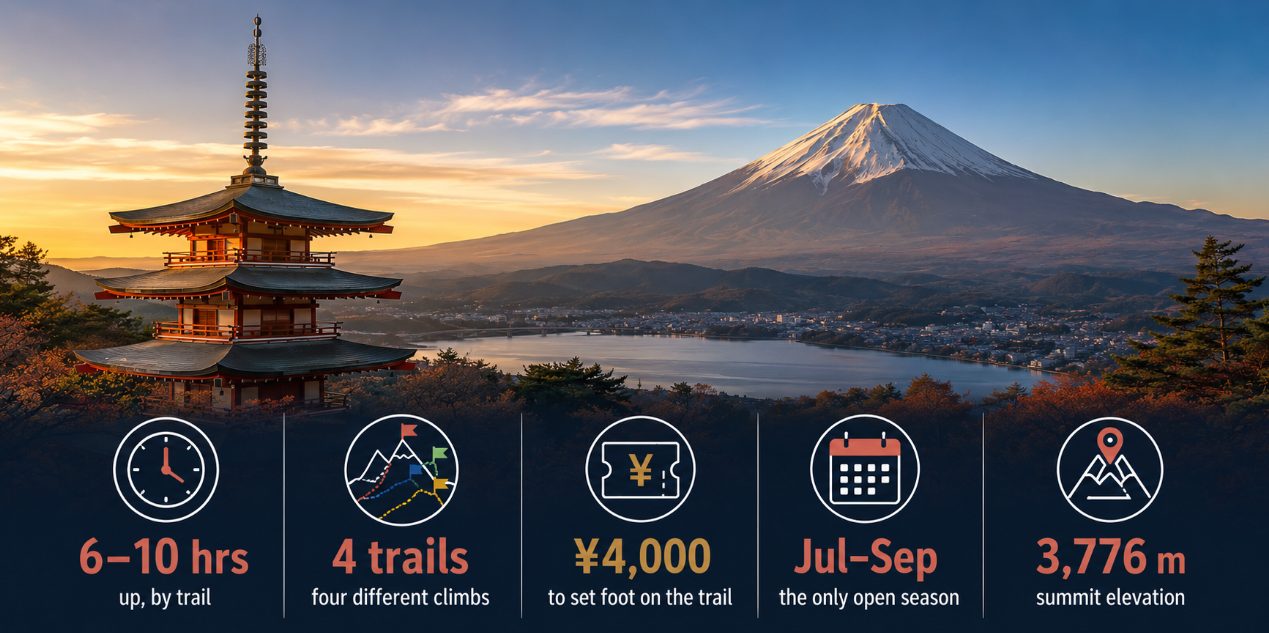
- Pay the ¥4,000 climbing fee and register online in advance. It applies to all four routes and covers first aid, shelters and mountain security. Yoshida also caps entry at 4,000 climbers a day — a ceiling that has never yet been reached, and which hut guests are exempt from anyway.
- Pass the kit check. Rangers turn people away at the trailhead: no proper boots, no warm layers, no waterproofs, no entry.
- Bring coins. Toilets are ¥100–300 each and there is no card reader at 3,000 metres.
If reading that list feels like a second job, the 2-day Mt. Fuji climbing tour with mountain guide folds the hardest parts into one booking — the mountain-hut night is included, which is exactly the piece that sells out months ahead when you arrange it yourself.
The One Thing That Decides How Your Climb Goes
Go slower than feels natural. Not fitness, not weather, not kit. Nearly every climber who had a bad time on Fuji was moving too fast for the altitude, and nearly every one who enjoyed it says some version of the same thing: let people overtake you.
You start the Yoshida trail at 2,300 m and finish at 3,776 m. That is high enough for altitude sickness to be routine rather than unlucky, and the only reliable defence is ascending gradually — which on a crowded summer night means deliberately walking slower than the queue around you.
“You’re over 3,000 metres and the pace is ridiculous. You’d get overtaken by a grandma walking to do her shopping.” — a climber who did the whole thing in a single day
It is easy to get this wrong precisely because the first hours feel easy. One climber, hurrying to make the sunrise, noted with some pride that he had passed everyone who set off ahead of him. He is also the one in this guide who got lost. Another, climbing with friends, spent the last stretch being told slow down, slow down by the one member of the group still thinking clearly.
Build the slowness into the plan rather than relying on willpower at 3 a.m.: split the climb over two days, sleep at a hut between the seventh and ninth stations, and treat the guidebook time for your trail as a floor, not a target. This is also the quiet argument for climbing with a mountain guide — a professional sets the pace your body needs rather than the pace the queue suggests.
What to Carry
The mountain is 30°C at the bottom and near freezing at the top, and there is nowhere to buy your way out of a mistake except at hut prices.
- Layers, more than you think. Summer at the fifth station is shorts weather, which is exactly why people underpack. A single jacket is not enough.
- Salt, not just sugar. Rice crackers, onigiri and electrolyte snacks. Salt replenishment and quick carbs help with the nausea that comes with altitude.
- Coins. For toilets and for branding your walking stick, one burn per station.
- A headtorch and a power bank. You will be walking in the dark, and the cold flattens phone batteries. One climber left his charger behind to save weight and regretted it before dawn.
- Painkillers. Altitude headaches are common enough that experienced climbers pack for them as a matter of course.
- Less of everything else. Every gram is one you carry for ten hours.
Where It Goes Wrong
Below the fifth station, not above it. Almost everyone starts at a fifth station, and the reason is the wooded trail underneath it. One climber walked up from the base alone at night, went two hours without passing another person, and arrived at the second station convinced he was twenty minutes from the fifth. If you want the full ascent from the shrine, do it in daylight and in company.
Coming down the wrong trail. The four routes are colour-coded, and the descent paths are separate from the ascent paths — which is how tired people in cloud end up on the wrong side of the mountain, hours from their bus. Learn your trail’s colour before you start and check it at every junction on the way down.
Waiting at the top. The summit is not somewhere you can rest. Wind strips the heat out of you within minutes of stopping, and climbers describe being unable to take a proper break at all — a serious problem if you arrive exhausted, in the dark, an hour before sunrise. Reach the top with something left, and keep moving while you wait.
Which Trail
Four routes, four different mountains. Around 3,500 people start up Fuji on a summer day, and roughly six in ten of them are on the same one.
| Trail | Starts at | Up | Crowds | Take it if |
|---|---|---|---|---|
| Yoshida | 2,300 m | ~6 hrs | Heavy — ~60% of all climbers | It is your first time |
| Fujinomiya | 2,400 m | 4–7 hrs | Second busiest | You want the shortest climb and you acclimatise well |
| Subashiri | 2,000 m | 6–8 hrs | About a third of Yoshida’s | You want shade and quiet without giving up the huts |
| Gotemba | ~1,450 m | 7–10 hrs | A tenth of Yoshida’s | You are fit, self-sufficient, and allergic to queues |
First time: take the Yoshida trail. Every climber in this guide who has done more than one route calls it the easiest, and busy is doing useful work for a beginner — the most huts, staff at the junctions, and a bus straight from Shinjuku to the trailhead. The price is the queue: on peak nights the final stretch feels, as one climber put it, more like waiting in line than hiking. The guided 2-day climb runs this route for exactly these reasons, with the hut night at altitude built in.
“Hardest” means two different things here, on two different trails. Gotemba is the endurance kind — it starts more than 800 metres below the others, and one climber who had done Yoshida before discovered the difference the hard way: “the Gotemba trail is the longest and the hardest, but for some reason this was kept a secret from me.” Fujinomiya is the steepness kind — the shortest route precisely because it climbs so directly. Pick your poison: hours or gradient.
And Gotemba divides the people who take it like no other trail — one climber came down recommending it, another came down swearing: “I would highly, highly, highly recommend that you do not take that god-forsaken trail.” Both are describing the same route accurately. What you get for the suffering is a trail that is genuinely empty — wide open where Yoshida is a procession — and the osunabashiri, the long volcanic sand-run where the descent becomes a half-running glissade.
Subashiri is the quiet compromise — the biggest forest zone of any route, separate up and down paths, and about a third of Yoshida’s traffic. Know that the quiet ends at the 8th station, where it merges with Yoshida for the final push: you climb alone and summit in the crowd.
Fujinomiya is the short one, with a catch. Starting at 2,400 m sounds like a gift and means the least time to acclimatise — the climber who trained hardest for it still budgeted ten hours and called the altitude the real opponent. It also uses the same path in both directions, so you meet everyone coming the other way.
One climber who knows the mountain well suggests the seasoned move: go up one of the quieter routes, then come down Gotemba’s sand run — two mountains for the price of one, and the emptiest possible descent.
What It Costs
| Item | Yen |
|---|---|
| Climbing fee, all four trails — compulsory, paid online, non-refundable | 4,000 |
| Mountain hut, no meals | 7,000–10,000 |
| Mountain hut with dinner and breakfast | 9,000–17,000 |
| Toilet, each time, coins only | 100–300 |
| Walking stick, from the fifth station | 1,500–2,000 |
| Branding it, one burn per station | 100–500 |
| Shuttle bus to the fifth station, return (private cars banned in season) | ~3,900 |
Figures verified for the 2026 season, 1 July – 10 September. Nothing above the fifth station takes a card — carry cash. Check the official climbing portal before you book.
Is It Worth It?
Yes, once. Go for the walk rather than the photograph. The sunrise is a lottery — one of the best accounts of this climb is by someone who got cloud at the top and still came down calling it a beautiful journey. People who summit Fuji describe it as worth it almost without exception. What almost nobody describes is wanting to do it twice.
The best-known account of this climb ends on exactly that note: “even though I’m a fool, it’s totally worth it — I’m really happy I came up here. Would I do it again? I don’t think I would.” That is not a complaint. It is what a once-in-a-lifetime mountain sounds like.
The one honest “no” comes from people who hike a lot. A climber with years of Japanese mountains behind her comes down on a flat no for hikers: the country is full of higher-quality walks with a fraction of the crowds. Then she turns straight around: if climbing the highest mountain in Japan is the bucket-list item, “of course you should hike Mount Fuji — nothing else is going to scratch the itch.” Fuji is a summit you collect, not a hike you savour. Decide which one you are buying, and you will come down happy.
And if that last paragraph described you — you want the mountain, not the climb — you do not need boots at all. The featured private Mt. Fuji tour circles the Five Lakes viewpoints in a day from Tokyo, and the helicopter tour puts you above the cloud deck that hides the summit from the ground all summer.
Ready to Climb?
The 2-day Mt. Fuji climbing tour with mountain guide runs the Yoshida route during the official season — mountain-hut overnight included, a guide who sets the pace the altitude demands, and the sunrise summit push timed properly. Prefer to see Fuji without climbing it? The private day tour is rated 5.0/5 and runs door-to-door from your Tokyo hotel.
Built from the first-hand accounts of climbers who have made the ascent, and verified against the official 2026 season rules. Prices and access rules change from season to season — check fujisan-climb.jp before you travel.
Your Private Mt. Fuji — Tailored to You
184 guests have rated this experience 5.0/5. Private car, English chauffeur, hotel pickup, customizable itinerary — from $325 per group with free cancellation.
Check Availability & Book