Mount Fuji in November: Clearer Skies, Red Maples, Shorter Days
November at Mount Fuji, checked against official records: the whole mountain visible on 54% of 8 am observations in Fuji City's 35-year record, a third of October's rain, the 2026 Autumn Leaves Festival dates, road hours, holidays, and how to plan a day trip from Tokyo.
November is when the Fuji Five Lakes come together: the air clears, the rain falls away, the maples around Lake Kawaguchiko turn, and the summit usually wears its first snow. It is also cold in the mornings, with sunset by about 4:40 pm, and busy on the weekends people come for the leaves.
The short version: between October and November, November gives you the better odds of seeing the whole mountain — just over half of mornings — and the morning is still when you see it. Go on a weekday if you can, avoid the 21–23 November holiday weekend if crowds bother you, and dress for near-freezing at the start of the day. If you are travelling earlier, read Mount Fuji in October.
Will You See Fuji in November?
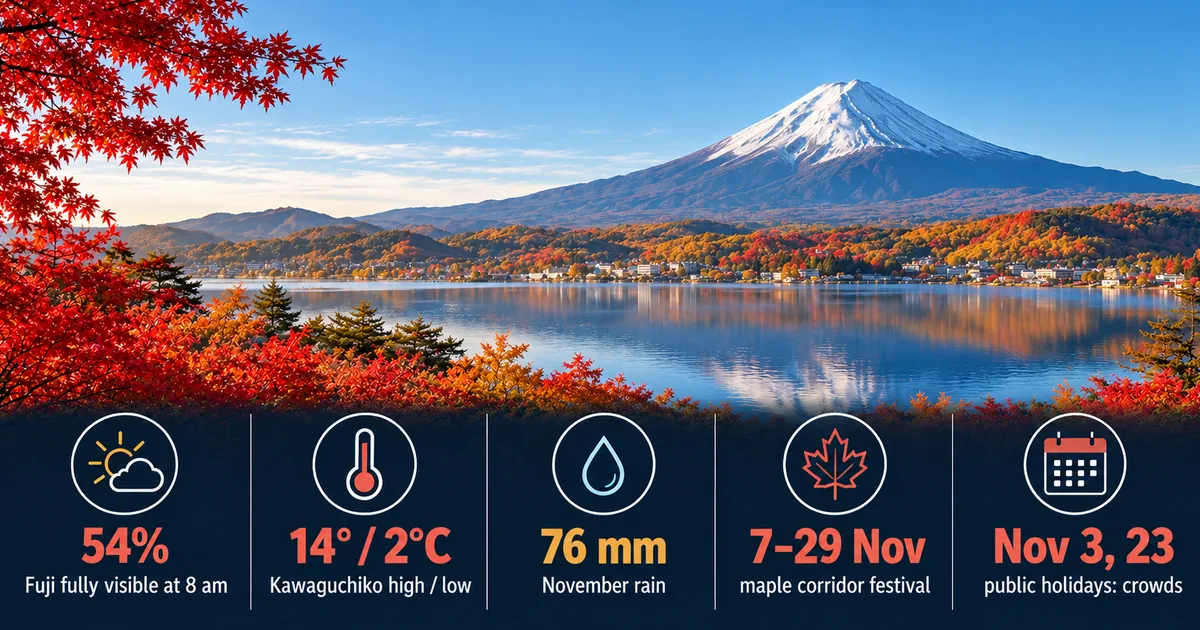
Fuji City, on the mountain’s south side, has recorded whether Fuji is visible from its city hall at 8 am, noon and 4 pm every day for more than three decades. Across the 35 years from 1991 to 2025, the whole mountain was visible at 8 am on 53.9% of November mornings, with another 24.8% partly visible. That is a clear step up from October (41.1%), and the start of the long clear season: the city’s report names November to February as the months with the most visible days. In November 2025 the mountain was fully visible at 8 am on 19 mornings and hidden on only 2.
Two patterns from the same record help you plan:
- Mornings still win. Across all months, the whole mountain was visible 36.6% of the time at 8 am, falling to 23.3% at noon and 22.5% at 4 pm.
- A sunny forecast is trustworthy now. From October to December, sunny days and fully visible days track closely, so a clear forecast for the lakes usually means a clear mountain.
These are Shizuoka-side figures, not a Kawaguchiko forecast, but they are the best long-run odds published. From Tokyo, averaging the Tokyo Metropolitan Government’s yearly counts from its Shinjuku building (1992–2025), Fuji appeared on about 11 November days — roughly twice October’s 6.
Weather and What to Pack
The Japan Meteorological Agency’s 1991–2020 normals for Lake Kawaguchiko (860 m) give November a daily high of 13.8 °C and a low of 2.2 °C. Rain falls to 76 mm, a third of October’s 230 mm, and sunshine rises to 166 hours. Snow at the lake is rare this early (the normal is 1 cm for the whole month).
Above the lakes, it is winter. JMA’s summit station averages a −5.9 °C high and −11.8 °C low in November, with mean winds of 13.2 m/s. JMA has no station at the fifth station, so it publishes no normals for it, but on a November morning it will be well below the lake shore’s temperature and often near or below freezing.
- A proper warm jacket, plus hat and gloves if you plan to stop at the fifth station or wait for sunrise light at the lake.
- Layers you can shed — a sunny lake-shore afternoon can feel mild.
- Warm socks and grippy shoes; early-morning paths can be frosty.
The Snowcap in November
Under the Kofu weather office’s old visual method, the normal date for Fuji’s first snowcap was 2 October, and the latest on record was 7 November 2024 — so by mid-November, in every year of that record, the cap had arrived. In 2025 it came on 23 October.
2026 is different in one way that matters: it is the first season the Japan Meteorological Agency determines the first snowcap from analysed snow depth rather than by eye, and JMA warns that the new dates cannot be simply compared with the old ones. As of 18 October 2026, no first snowcap had been announced and the summit was listed as snow-free. Early snow can also melt within days; in November 2024 the first white had largely gone again within a few days, as NASA’s satellite images showed. A white peak is likely in November, then, but look at a recent webcam image before you book around it.
Autumn Leaves and the Festival
This is the month people come for, and the official dates are set:
- Fuji Kawaguchiko Autumn Leaves Festival: Saturday 7 – Sunday 29 November 2026, at the festival grounds by the Momiji Corridor on the north shore, with the maples lit up from sunset to 21:00 (per the town’s official tourism site; some aggregators give later times — trust the official one).
- The town’s 2026–27 guidebook puts the peak in early to mid November. The corridor itself, about 150 maples along the Nashigawa stream, is listed as best from late October to mid November.
- Weathernews forecasts the 2026 lake-shore peak from about 16 November, with leaves starting to fall around 29 November, and says this autumn’s warmth is running colour slightly later than normal in many places.
Beyond Kawaguchiko:
- Hakone colours from the top down. The official tourism association’s typical progression: Sengokuhara, Moto-Hakone and Lake Ashi in early November; Gora, Kowakudani and Miyanoshita in mid to late November; Hakone-Yumoto from late November into early December.
- Shiraito Falls: Yamanashi’s tourism organisation gives late October to late November for foliage, and sunny mornings for the falls’ rainbow.
- Diamond Fuji at Lake Yamanaka: in early November, Yamanashi Tourism’s guide dates put the sun setting onto the summit as seen from Nagaike Waterside Park. It happens at sunset, so it means a late finish on a day trip from Tokyo — ask when you book.
- Fujisan, Lake & Momiji Walk: Fujikawaguchiko town’s walking event, 14–15 November, based at Oike Park. Expect walkers on the lake-shore roads that weekend.
Getting Up the Mountain: Roads and Trails
The Fuji Subaru Line changes hours mid-month: 04:30–17:00 from 1 to 15 November, then 09:00–17:00 from 16 to 30 November (last cars down an hour after closing). The round-trip toll for an ordinary car is ¥2,800, cash or coupon books only. The road can close at short notice for strong wind, ice, snowfall or snow cover, and the toll is not refunded if weather stops you short of the top. Last winter it kept reaching the fifth station until 18 January.
The Shizuoka-side fifth-station roads close for winter in November. Last season the Fujisan Skyline (Fujinomiya side) closed fully on 9 November 2025, a day earlier than planned. The 2026 closure dates had not been announced at the time of writing. For a November visit, the fifth station means the Yoshida (Subaru Line) side.
The climbing season is long over. The official portal says all summit trails are closed outside the 1 July – 10 September season; climbing is prohibited for anyone not fully prepared, a climbing plan is required, and officials strongly advise against it. See our climbing guide for next summer.
Crowds, Holidays and Daylight
Two national holidays fall in November 2026:
- Culture Day, Tuesday 3 November. Monday the 2nd is a normal working day, though many people take it off. It is also the day of the 73rd Hakone Daimyo Gyoretsu, the feudal-lord procession through Hakone-Yumoto — worth seeing if you are in Hakone, and a reason to expect traffic there.
- Labour Thanksgiving Day, Monday 23 November, which makes 21–23 November a three-day weekend — inside the festival and right in Weathernews’ forecast peak window. Expect it to be the busiest stretch of the month.
The lakes’ tourism offices advise public transport because parking is limited. On festival weekends, a driver who knows where to drop you off is worth a lot.
The days are short. The National Astronomical Observatory’s tables for nearby Kofu put sunset at 16:51 on 1 November, 16:39 on the 15th and 16:33 on the 30th — roughly half an hour earlier than mid-October. Afternoon stops lose their light sooner, and the illuminated maples start before 5 pm.
How to Plan a November Day Trip
- Pick a weekday, and pick the sunniest one. November’s forecasts are a good guide to visibility. Free cancellation lets you move if the outlook turns.
- Start early, but think about the Subaru Line. Before the 16th the road opens at 04:30; from the 16th it does not open until 09:00. In the second half of the month, do the lakes and Chureito Pagoda first in the clear morning light, then the fifth station mid-morning.
- Time the colour. For Kawaguchiko’s maples, the second and third weeks of November are the safest bet this year; for Hakone’s lake-level colour, early November.
- Decide on the light-up. Staying for the illuminated corridor means leaving the lakes after dark and getting back to Tokyo late. It is easier on a private tour, where the schedule is yours.
- Dress for 2 °C, and bring a hat and gloves for the fifth station.
Which Tour Fits November
The featured private Mt. Fuji tour suits November well. Your own car and English-speaking chauffeur pick you up at your Tokyo hotel, and you shape the day: the Momiji Corridor and Lake Kawaguchiko early, the fifth station once the Subaru Line opens, Shiraito Falls or Hakone’s colour if you prefer. It runs from US$368 a car for up to 3, or US$398 for a minivan for up to 6 (regular prices), with free cancellation up to 24 hours before. The itinerary guide lays out what it can cover, and Hakone vs Mount Fuji helps if you are torn between the two.
For a budget day, the shared Mt. Fuji, Hakone Ropeway and Lake Ashi day trip is the group alternative: a coach from Tokyo Station (8:00) or Shinjuku (8:30), a multilingual guide, Hakone Shrine, the ropeway and Owakudani — good timing for Hakone’s early-November colour — then Lake Yamanaka and Oshino Hakkai in the afternoon, from US$75 per person (regular price). In November, those Fuji-side stops come at about 3–4 pm, close to sunset, and the operator warns that return times can slip by hours on peak weekends and holidays. The private vs group guide compares the two by group size.
November at Fuji: Questions People Ask
Will Mount Fuji have snow in November?
Very likely, but check. Under the old visual method, the latest first snowcap on record was 7 November 2024, and in 2025 it came on 23 October. As of 18 October 2026, the Japan Meteorological Agency had not announced this year’s first snowcap, and 2026 is the first season it uses analysed snow depth rather than eyesight to decide it. Early snow can also melt off within days.
Is November a good time to see Mount Fuji?
Yes — it is the best month of the autumn for it. Fuji City’s 35-year record shows the whole mountain visible at 8 am on 53.9% of November mornings, against 41.1% in October, and Kawaguchiko gets a third of October’s rain.
When is the best time to see the autumn leaves at Mount Fuji in 2026?
The town’s official guide puts the Lake Kawaguchiko peak in early to mid November, and Weathernews forecasts the 2026 lake-shore peak from about 16 November. The Fuji Kawaguchiko Autumn Leaves Festival runs 7–29 November 2026, with the maples lit from sunset to 21:00.
What should I wear to Mount Fuji in November?
A warm jacket and layers. At Lake Kawaguchiko the normal November high is 13.8 °C and the low 2.2 °C; the fifth station is colder and windier. Add a hat and gloves if you will be outside early or at altitude.
Can you go to the fifth station in November?
Yes, on the Yamanashi side via the Fuji Subaru Line: 04:30–17:00 until 15 November, then 09:00–17:00. The toll is ¥2,800 round trip for an ordinary car, cash or coupons only, and the road can close for wind, ice or snow without a refund. The Shizuoka-side fifth-station roads close for winter during November.
Can you climb Mount Fuji in November?
No, not as a normal visitor. All summit trails are closed outside the July–September season, climbing is prohibited for anyone not fully prepared, a climbing plan is required, and officials strongly advise against it.
Is Mount Fuji crowded in November?
On leaf weekends, yes. The busiest stretch is likely to be 21–23 November, a three-day holiday weekend during the festival and near the forecast peak. Culture Day on 3 November also draws crowds, especially in Hakone. Weekdays are noticeably calmer.
Ready to Book?
The private Mt. Fuji tour is rated 4.9/5 from over 1,400 reviews — private car, English-speaking chauffeur, hotel pickup and an itinerary built around the leaves and the light, from US$368 a car for up to 3, or US$398 for a minivan for up to 6 (regular prices). Visiting earlier? Read Mount Fuji in October, or see the season-by-season guide for the rest of the year.
Checked in October 2026 against the Japan Meteorological Agency, Fuji City’s visibility records, the Tokyo Metropolitan Government, the Cabinet Office holiday calendar, the National Astronomical Observatory of Japan, the Fuji Subaru Line operator, the official Mt. Fuji climbing portal, and the Fujikawaguchiko, Hakone, Fujinomiya and Yamanashi tourism bodies. Festival times, road hours and snow status can change; check them the day before you travel.
Your Private Mt. Fuji — Tailored to You
Private car, English-speaking chauffeur, hotel pickup, customizable itinerary — from US$368 per group up to 3, with free cancellation.
Check Availability & Book