Mount Fuji in October: What the Month Is Really Like
October at Mount Fuji, checked against official records: the whole mountain visible on 41% of 8 am observations in Fuji City's 35-year record, the year's second-wettest month, no snowcap yet in 2026, and how to plan a day trip from Tokyo around all of it.
October is a month of transition at Fuji. Summer’s haze has gone, the climbing season is over, the maples are only starting to turn, and the mountain usually shows itself on a good morning — but it is also one of the wettest months of the year at the lakes, and as of 18 October 2026 no first snowcap had been announced.
The short version: the mountain is fully visible on roughly two October mornings in five, and the morning is when you will see it. Plan a day trip that reaches the viewpoints early, keep a second date in reserve if your schedule allows, and if the cap and the red leaves matter more to you than anything else, November is the better bet.
Will You See Fuji in October?
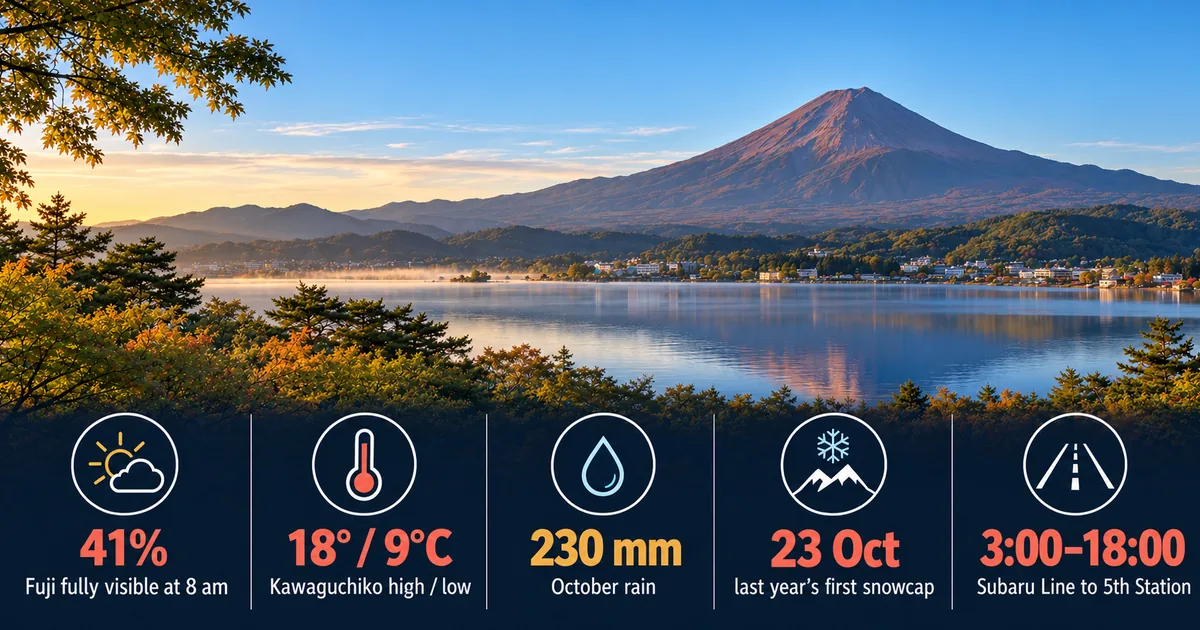
Fuji City, on the mountain’s south side, has logged whether Fuji is visible from its city hall at 8 am, noon and 4 pm every day for more than three decades. Over the 35 years from 1991 to 2025, the whole mountain was visible at 8 am on 41.1% of October mornings, and partly visible on another 27.7%. November rises to 53.9%; the summer months sit between 10% and 15%.
Two things in that record matter for planning:
- Mornings win. Across all months, the whole mountain was visible 36.6% of the time at 8 am, 23.3% at noon and 22.5% at 4 pm. The city’s own report puts it plainly: visibility is best at 8 am and tends to get worse into the afternoon.
- In October a clear plain usually means a clear mountain. The same report notes that from October to December, sunny days and fully visible days track closely, unlike May to September, when sunshine down below often still leaves Fuji in cloud. If the forecast says sunny, you can mostly believe it.
Fuji City is on the Shizuoka side, not at Lake Kawaguchiko where most day trips go, so treat these as the best long-run odds available rather than a Kawaguchiko forecast. From Tokyo, the gap is wider: averaging the Tokyo Metropolitan Government’s yearly counts from its building in Shinjuku (1992–2025), Fuji showed itself on about 6 October days, against about 11 in November.
Weather and What to Pack
At Lake Kawaguchiko (860 m), the Japan Meteorological Agency’s 1991–2020 normals for October are a daily high of 18.3 °C and a low of 8.7 °C. That is a pleasant day by the lake and a cold start if you leave Tokyo before dawn.
The rain is the part people underestimate. Kawaguchiko averages 230 mm in October, second only to September, and 134 hours of sunshine. November drops to 76 mm. Early October still sits in the tail of typhoon season: JMA’s normals give October 0.5 typhoon approaches to the Kanto-Koshin region (September 1.0, November none), and October 2025 had two.
Higher up it is another season entirely. JMA’s summit station (3,775 m) averages a 0.7 °C high and −5.1 °C low in October. JMA has no station at the fifth station, so it publishes no normals for it, but expect it to be markedly colder and windier than the lake shore.
What that adds up to:
- Layers. A warm mid-layer and a windproof jacket, even if Tokyo feels mild. You will be standing still at viewpoints, which is colder than walking.
- A rain shell or umbrella, given the month’s rainfall.
- Shoes with grip for wet paths at Oshino Hakkai and the steps up to Chureito Pagoda.
Snowcap Status in October 2026
As of 18 October 2026 (3 am JST), the Japan Meteorological Agency had not yet announced Fuji’s first snowcap, and listed the summit as snow-free.
Two things make this year different from the guidebooks:
- The method changed. Until last season, staff at the Kofu weather office declared the first snowcap by looking at the mountain. That visual observation ended after the 2025 snowcap, and from this autumn JMA determines the date from analysed snow depth instead. JMA itself warns that new-method dates cannot be simply compared with the old ones.
- The old normal is early. Under the retired visual method, the 1991–2020 normal was 2 October. The last two years ran late: in 2024 the cap was not observed until 7 November, the latest on record, and in 2025 it came on 23 October.
So a capped Fuji in October is possible but not something to plan around. A first dusting can also melt within days, as NASA’s satellite images showed in November 2024. If the white peak is the photograph you came for, November and later give far better odds.
Autumn Colour and What’s On
The colour starts at the end of the month. Fujikawaguchiko town’s official guide gives the autumn-leaves season as late October to late November, with the peak in early to mid November; the Momiji Corridor (about 150 maples along the Nashigawa stream on the north shore) is listed as best from late October to mid November. Weathernews forecasts the 2026 lake-shore peak from about 16 November and says in its national outlook that this year’s warm autumn is running colour slightly later than normal in many places. In other words, late-October visitors see the first reds, not the full show.
Elsewhere on the usual day-trip map:
- Hakone: the official tourism association describes colour starting on the higher peaks (Kamiyama, Kintoki-san) from late October, then moving down through Lake Ashi and Sengokuhara in early November.
- Shiraito Falls: Yamanashi’s tourism organisation lists the foliage window as late October to late November, and notes the falls’ rainbow appears on sunny mornings in any season.
- Diamond Fuji at Lake Yamanaka: in mid to late October, Yamanashi Tourism’s guide dates place the sun setting directly onto the summit as seen from Panorama-dai and the Asahigaoka lakeside. It is a sunset event, so on a day trip from Tokyo it means a late finish; ask about it when you book rather than assuming it fits.
The Fuji Kawaguchiko Autumn Leaves Festival does not open until 7 November — see the November guide.
Getting Up the Mountain: Roads and Trails
The Fuji Subaru Line is open 03:00–18:00 in October (last cars down by 19:00), the road that takes cars and tour vehicles to the Yoshida-side fifth station. The round-trip toll for an ordinary car is ¥2,800, cash or coupon books only. The operator closes the road, sometimes within hours, for heavy rain, strong wind or ice, and does not refund the toll if weather stops you short of the top. In an October storm, the fifth station is the stop most likely to drop off your day.
The climbing season is over. The 2026 season ran 1 July to 10 September (from 10 July on the Fujinomiya and Gotemba trails). Outside it, the official climbing portal says all trails to the summit are closed, climbing is prohibited for anyone not fully prepared, those who do go must submit a climbing plan, and officials “absolutely do not recommend” it. A day visitor can still stand at the fifth station and walk around it; the summit is a summer project. Our climbing guide covers next season.
Crowds and Holidays
This year’s October public holiday, Sports Day, fell on Monday 12 October, so the rest of the month has no national holiday. Weekends are still busier than weekdays at the lakes, and the local tourism offices advise public transport because parking is limited. A weekday trip in the second half of October is about as quiet as autumn gets here, just before November’s colour and festival bring the bigger crowds.
Daylight is shrinking fast. The National Astronomical Observatory’s tables for nearby Kofu put sunset at 17:11 on 15 October and 16:52 on 31 October, which is one more reason to front-load the day.
How to Plan an October Day Trip
- Watch the forecast for the two or three days you could go, then pick the sunniest. In October a sunny forecast is a reasonable proxy for a visible mountain. Booking with free cancellation leaves you room to move.
- Leave Tokyo early. The aim is to reach the first viewpoint while the 8 am odds still hold. Put the mountain-view stops first and the indoor or shaded ones — shrines, Oshino Hakkai’s ponds, lunch — later.
- Keep the fifth station optional. If the Subaru Line is closed or the summit is in cloud, the lakes and Chureito Pagoda are a better use of the morning.
- Pack for 9 °C, not 18 °C, and bring rain gear.
- Wait out a cloud. If Fuji is hidden when you arrive at a viewpoint, 15–20 minutes sometimes opens a gap.
Which Tour Fits October
October rewards flexibility, which is the main argument for a private car this month.
The featured private Mt. Fuji tour is a full day with your own car and English-speaking chauffeur, picking you up at your Tokyo hotel. You set the order, so you can tell the driver the evening before to start early and take the viewpoints first, swap the fifth station for the lakes if the road is closed, or add Shiraito Falls on a sunny morning. It runs from US$368 a car for up to 3, or US$398 for a minivan for up to 6 (regular prices), with free cancellation up to 24 hours before — useful in a month when the forecast decides the day. The itinerary guide shows the stops it can cover.
On a tighter budget, the shared Mt. Fuji, Hakone Ropeway and Lake Ashi day trip is the group alternative: a coach from Tokyo Station (8:00) or Shinjuku (8:30), a multilingual guide, Hakone Shrine, the ropeway and Owakudani, then Lake Yamanaka and Oshino Hakkai in the afternoon, from US$75 per person (regular price). The trade-off this month is timing: its Fuji-side stops come after 3 pm, when Fuji City’s all-year record shows the lowest odds, and the operator itself notes that visibility is not guaranteed and that stops can change with traffic and weather. The private vs group guide runs the numbers for different group sizes.
October at Fuji: Questions People Ask
Will there be snow on Mount Fuji in October?
Possibly, but not reliably. The old visual-method normal for the first snowcap was 2 October, but recent years have been late: 23 October in 2025 and 7 November in 2024, the latest on record. As of 18 October 2026, JMA had not announced this year’s first snowcap and listed the summit as snow-free. This is also the first season JMA uses analysed snow depth rather than eyesight, so this year’s date is not directly comparable with the old ones.
Is October a good time to see Mount Fuji?
It is decent, not the best. Fuji City’s 35-year record shows the whole mountain visible at 8 am on 41.1% of October mornings, far better than summer but behind November (53.9%) and the winter months. Go in the morning and pick a sunny forecast day.
What is the weather like at Mount Fuji in October?
At Lake Kawaguchiko the normal daily high is 18.3 °C and the low 8.7 °C, with 230 mm of rain over the month, the second-wettest month after September. The summit station averages below freezing. Bring layers and rain gear.
When do the autumn leaves turn at Mount Fuji?
From late October at Lake Kawaguchiko, peaking in early to mid November according to the town’s official guide. Weathernews forecasts the 2026 lake-shore peak from about 16 November. Late October gives you the start of the colour.
Can you climb Mount Fuji in October?
Not in the ordinary sense. The official season closed on 10 September. Outside it, all summit trails are closed, climbing is prohibited for anyone not fully prepared, a climbing plan is required, and officials strongly advise against it. You can still visit the fifth station by road.
Can you go to the fifth station in October?
Yes, on the Yamanashi side. The Fuji Subaru Line is open 03:00–18:00 through October, with a ¥2,800 round-trip toll for an ordinary car (cash or coupons only). It can close at short notice in heavy rain, strong wind or ice, with no toll refund.
Is Mount Fuji crowded in October?
Less than in November. The only October public holiday, Sports Day, was on 12 October this year, so late-October weekdays are among the quieter autumn days. Weekends are still busier.
Ready to Book?
The private Mt. Fuji tour is rated 4.9/5 from over 1,400 reviews — private car, English-speaking chauffeur, hotel pickup and an itinerary you can reshuffle around the weather, from US$368 a car for up to 3, or US$398 for a minivan for up to 6 (regular prices). Thinking about later in the autumn? Read Mount Fuji in November, or the season-by-season guide for the whole year.
Checked in October 2026 against the Japan Meteorological Agency, Fuji City’s visibility records, the Tokyo Metropolitan Government, the Fuji Subaru Line operator, the official Mt. Fuji climbing portal, and the Fujikawaguchiko, Hakone and Yamanashi tourism bodies. Road hours and snow status change quickly; check them the day before you travel.
Your Private Mt. Fuji — Tailored to You
Private car, English-speaking chauffeur, hotel pickup, customizable itinerary — from US$368 per group up to 3, with free cancellation.
Check Availability & Book